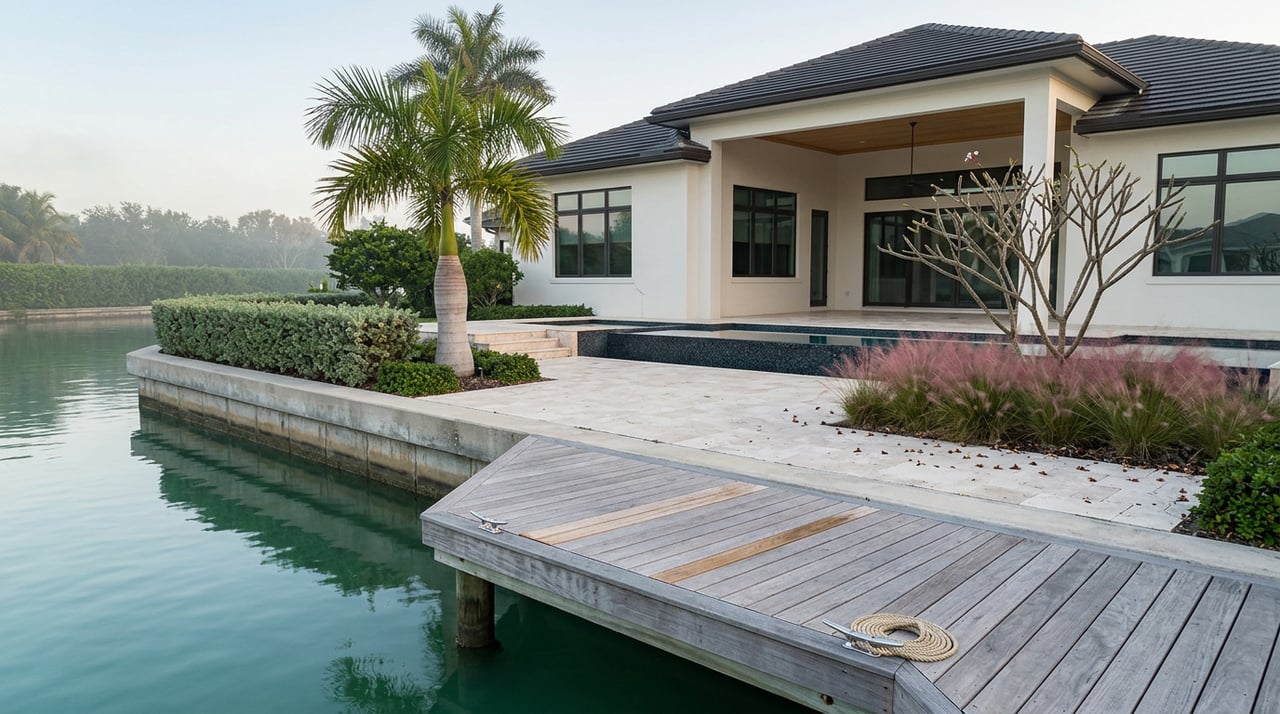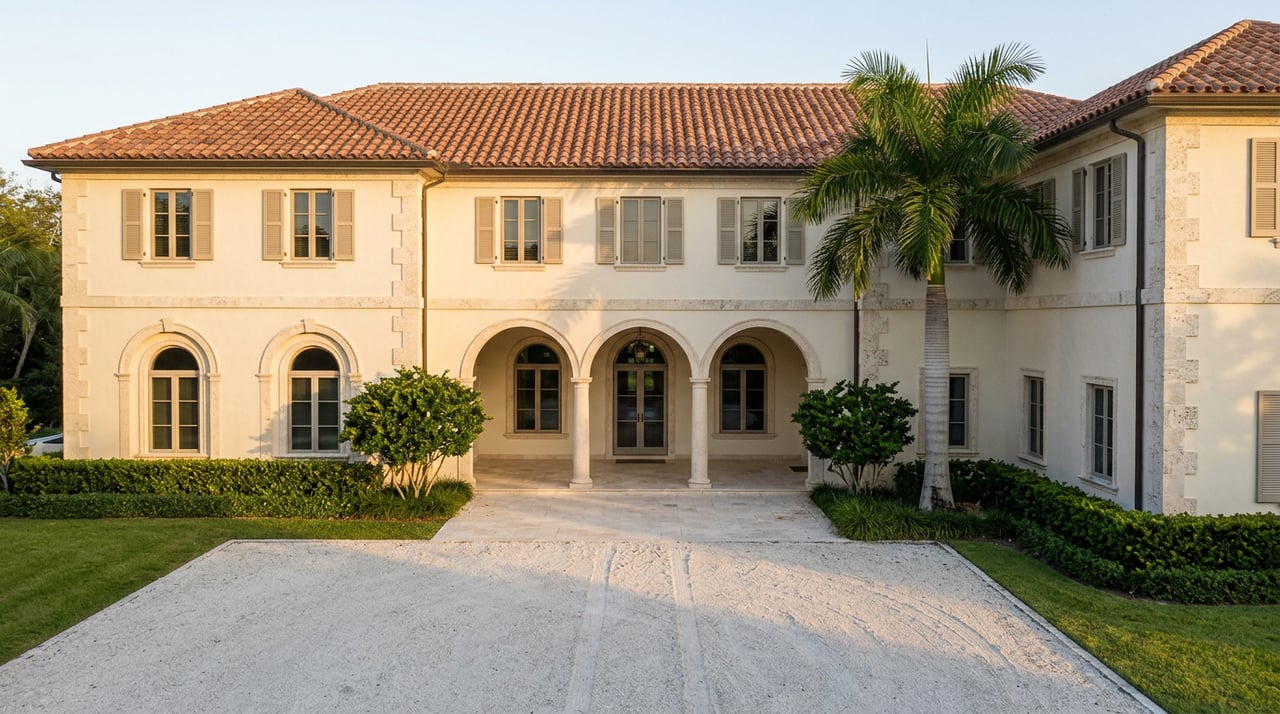
Jay and Christi Turner paid $21.6 million last September for half of a century-old oceanfront estate called Miradero, once owned by Lila Vanderbilt Webb. The property at 1443 N. Ocean Blvd. had belonged to the late Bob Ganger, a former Gulf Stream town commissioner and vice mayor who spent decades documenting the house's history. The Turners assembled a design team and set out to bring the place into the current century.
By June, architect Richard Sammons stood in front of the Gulf Stream Town Commission asking for 2,605 square feet more than the property's allowable floor area. He learned what most buyers in this town eventually learn one way or another: the price on the deed has nothing to do with what the town will let you build.
What the Sale Price Didn't Include
Miradero was split into two properties in the 1930s, sharing a common wall. Sammons described the Turners' half as the estate's original master bedroom and service wing, with the northern side, sold separately for $16.65 million in 2023, holding the tower and what he called the estate's "pleasure dome." The Turners' plan to modernize their half ran straight into the ceiling on total floor area allowed under Gulf Stream's code.
The commission sent the application back to the Architectural Review and Planning Board and told the design team to rework it with staff before returning. Nine weeks later, on August 14, designer Scott Collison came back with a revised plan. Living space in the main house had been converted to a single-car garage. Two of the four bays in what Sammons called an "enormous" garage were gone. The overage had dropped from 2,605 square feet to 959. It still wasn't enough. Commissioner Joan Orthwein put the town's position on the record plainly:
"You're requesting a variance still and you know at the town we really don't grant variances overall."
That sentence is the piece of local knowledge every prospective Gulf Stream buyer needs before they price a renovation. This isn't a town that negotiates on floor area because the house is old or the buyer is well capitalized. It's a town that has built its entire identity around not doing that.
Why the Design Manual Wins Almost Every Time
Gulf Stream's zoning code requires new construction and major renovations to comply with the town's Design Manual, a document that governs massing, roof form, materials, window proportions, and exterior color for single-family homes. The stated goal, written into the town's own code, is that structures "contribute to the image of the Town as a place of beauty, spaciousness, balance, taste, fitness, charm and high quality." That's not marketing language. It's the actual legal standard the Architectural Review and Planning Board applies when it reviews your plans.
The town runs three tiers of review. Level 1 covers minor work, accessory structures, and anything affecting less than 300 square feet, and town staff can approve or deny it directly. Level 2 covers larger expansions, demolitions, and anything using a discouraged architectural style or material, and it goes to the five-member Architectural Review and Planning Board, which meets the fourth Thursday of every month at 8:30 a.m. at Town Hall on Sea Road. Level 3, the tier the Turners eventually needed, requires the full Town Commission to weigh in after hearing the board's recommendation. There is no fast lane for larger budgets. There's just a longer path through more meetings.
The Review Reaches Smaller Projects Than You'd Expect
It isn't only nine-figure estate remodels that run into this. At a separate Planning Board meeting, a resident on Avenue O tried to re-roof a home originally built in the Gulf Stream Bermuda style, which had been altered over the years into something closer to a ranch house. The white ceramic roof tile he wanted had become nearly impossible to source with a reliable warranty, so he asked to substitute a "brown sugar" tone that matched his home's existing hardscape. Board members pushed back, not on the color choice itself but on what it implied about a home whose architectural classification had already drifted from its original style.
That meeting says more about how this town operates than any headline sale ever will. A roof isn't a floor area question. It's a maintenance decision most homeowners elsewhere handle without a second thought. In Gulf Stream, it can turn into a conversation about whether your house still qualifies as the style it was built in.
Your Permit Isn't Actually Issued by Gulf Stream
Here's the detail that surprises even experienced South Florida contractors: Gulf Stream does not process its own building permits. The town has an interlocal agreement with the neighboring Town of Highland Beach, which runs a fully digital permitting system. Every application, whether it's a new roof or a full teardown, has to go through Highland Beach's online portal under the Gulf Stream jurisdiction. No paper applications are accepted. Fees are set and collected by Highland Beach's schedule, not Gulf Stream's, and inspections are scheduled through the same system.
Design approval and permit issuance are two separate governments talking to each other. Your architect can win over Gulf Stream's Architectural Review and Planning Board and still hit friction on the Highland Beach side if the digital submission doesn't match what the board approved. Contractors who've only worked in Gulf Stream's neighboring towns sometimes don't realize this handoff exists until their first project there.
What This Means Before You Write an Offer
If you're buying a property in Gulf Stream with renovation plans already in mind, the sale price is the easy part. The variables that actually determine your timeline live in town records, not the listing sheet.
Before you get too attached to a specific redesign, it's worth doing three things:
- Ask the town clerk's office whether the property has any prior Architectural Review and Planning Board history, including past denials or conditions attached to earlier approvals
- Schedule a pre-application meeting with the town before you finalize architectural plans, which the town requires for any exterior remodeling, major landscaping, or significant property improvement
- Confirm with your contractor that they're prepared to submit through Highland Beach's digital portal, not Gulf Stream's own office, since a contractor unfamiliar with that handoff can lose weeks to a resubmission
None of this means Gulf Stream is a difficult place to own property. It means the town has been explicit, for a century now, about what it's protecting and how little it's willing to bend to get there.
A Few Direct Questions
Does the Design Manual apply to interior work too? The board's review authority is tied to what's visible from outside the home and to floor area limits, not interior finishes. Interior renovations that don't touch massing, exterior materials, or total square footage generally move through the process faster.
Can I request Architectural Review and Planning Board history on a specific address before I buy? Yes. The town clerk's office keeps records of prior applications, approvals, and denials tied to a property, and reviewing that history before you write an offer contingent on renovation is a reasonable step for any buyer with design plans.
Who do I actually call to start the permit process? Gulf Stream's Town Clerk handles the pre-application meeting on the design side. Once plans are approved, the permit itself is submitted through the Town of Highland Beach's online portal under the Gulf Stream jurisdiction, and Highland Beach handles issuance and inspections from there.
Gulf Stream rewards buyers who do their homework before closing, not after. If you're weighing a purchase here with a renovation in mind, or trying to understand what a specific address's approval history might mean for your plans, The Olive Belcher Team can walk you through what the town's records actually show before you're the one standing in front of the commission. Request a Private Consultation to start that conversation.